



- .... - ... .., .... | ..:..
- ....... | ..
- ... | ..
- Intranet Login
Thursday, 13 August 2026
Protecting Village Safety, MDA Strengthens Rante Balla Residents’ Emergency Preparedness
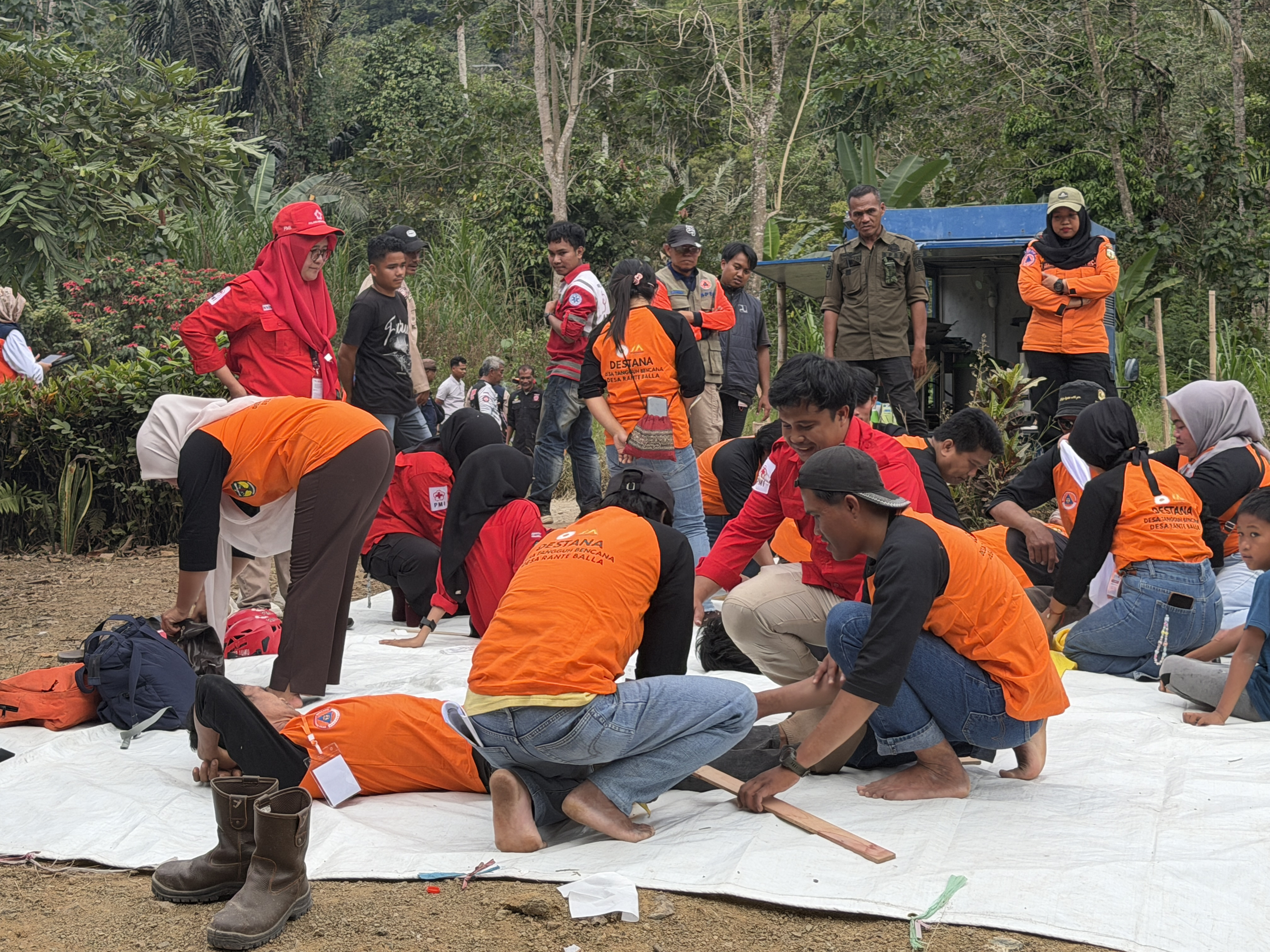
PT Masmindo Dwi Area (MDA) continues to strengthen its Jaga Keselamatan Desa (Village Safety Initiative) through capacity building for the Disaster-Resilient Village (DESTANA) in Rante Balla Village, Latimojong District, Luwu Regency. This time, the capacity-building initiative focused on the community’s ability to manage a communal kitchen, an essential component of emergency response and post-disaster relief efforts.
In collaboration with the Center for Mapping and Disaster Studies (PUSPENA) of Universitas Cokroaminoto Palopo (UNCP), the activity involved the Luwu Regency Social Affairs Office, the Luwu Regency Regional Disaster Management Agency (BPBD), the Indonesian Red Cross (PMI), the Disaster Research Center of Hasanuddin University, MDA’s Emergency Response Team (ERT), and local residents. The collaboration forms part of an effort to establish coordinated preparedness at the village level.
During the simulation, residents not only gained an understanding of the functions of a communal kitchen but also participated directly in the various stages of its operation. These included assigning roles and coordinating personnel, managing food supplies, preparing meals, and distributing food to affected communities.
The Secretary of the Luwu Regency Social Affairs Office, Drs. Rusdin, M.Si., said that the ability to meet people’s basic needs is an important aspect of a village’s resilience when facing disasters.
“Village resilience is not only measured by the community’s ability to save themselves from disaster threats, but also by its ability to ensure that no resident loses access to basic necessities after a disaster occurs. A communal kitchen is one tangible manifestation of this social awareness, when safety is no longer understood merely as individual safety, but as a shared responsibility to ensure the safety and continuity of life for everyone,” Rusdin said.
According to him, the involvement of the government, community, humanitarian organizations, and companies in the simulation is also important for establishing coordination before an emergency occurs. In this way, each party understands the role it needs to play when responding to a disaster situation.
Chairman of PUSPENA UNCP, Dr. Ichwan Muis, said that community preparedness cannot be built solely through technical knowledge of disaster management. The ability of residents to identify risks, organize themselves, and utilize available resources within the village is equally important to enable communities to take an active role during emergencies.
“Disaster-Resilient Villages are established to identify risks, organize communities, and foster social awareness to safeguard village safety,” Ichwan said.
MDA’s Chief Mining Engineer (KTT), Mustafa Ibrahim, said that strengthening community capacity is an important part of the Jaga Keselamatan Desa program. According to him, preparedness is not simply about knowing what to do when a disaster occurs, but also about enabling communities to organize themselves and meet basic needs during an emergency.
“Preparedness must be built before an emergency occurs. Through exercises like this, communities not only understand their roles but also gain practical experience in working together, managing available resources, and responding to situations in a more organized manner. This is what we seek to continuously strengthen through Jaga Keselamatan Desa,” Mustafa said.
The communal kitchen simulation in Rante Balla complements the series of DESTANA capacity-building activities carried out by MDA in collaboration with PUSPENA and relevant stakeholders. Through this program, the capacities developed are expected to become increasingly embedded at the village level and be readily utilized by the community when facing emergency situations.
Source: masmindo.co.id
Read the full story
Sitemap